
The Reverse Conway Maneuver
One of the most important lessons I have learned in enterprise software architecture is that organizational structure matters just as much as technical architecture.
Possibly more.
Many organizations attempt large-scale modernization efforts:
- microservices
- domain-driven design
- event-driven architectures
- micro-frontends
- CI/CD transformations
- cloud-native migrations
while leaving their organizational structure fundamentally unchanged.
Years later, leadership wonders why:
- systems remain tightly coupled
- deployments are still slow
- dependencies continue growing
- ownership remains unclear
- teams struggle with coordination
- architecture quality degrades over time
The answer is usually Conway’s Law.
What Conway’s Law Actually Means
Melvin Conway observed:
“Organizations which design systems are constrained to produce designs which are copies of the communication structures of these organizations.”
In practice, this means:
- centralized organizations produce centralized systems
- siloed organizations produce siloed architectures
- activity-based teams produce tightly coupled systems
- stream-aligned teams produce modular systems
Architecture is not purely a technical exercise.
It is a social one.
Martin Fowler and others repeatedly reinforce this idea in modern organizational design discussions. As Fowler describes in Activity-Oriented Organizations:
“Activity-oriented teams are prone to optimize for their own activity and not for the bigger picture of delivering useful software.”
That single sentence explains why so many enterprise modernization efforts fail despite significant technical investment.
The Architecture Organizations Say They Want
Most enterprise organizations today claim they want:
- loosely coupled systems
- autonomous teams
- independent deployments
- rapid delivery
- high resiliency
- scalable ownership
- product-oriented thinking
This usually leads to technical initiatives around:
- APIs
- event-driven design
- domain-driven design
- microservices
- micro-frontends
- bounded contexts
But many organizations stop there.
They modernize the technology stack while preserving:
- project-based funding
- centralized governance
- horizontal teams
- ticket-driven infrastructure
- approval chains
- shared ownership
- release coordination offices
This creates structural contradiction.
You Cannot Build Autonomous Systems with Non-Autonomous Teams
This is one of the hardest realities for leadership to accept.
If teams do not own:
- architecture
- infrastructure
- deployments
- operations
- testing
- observability
- domain decisions
then the systems themselves will not become autonomous.
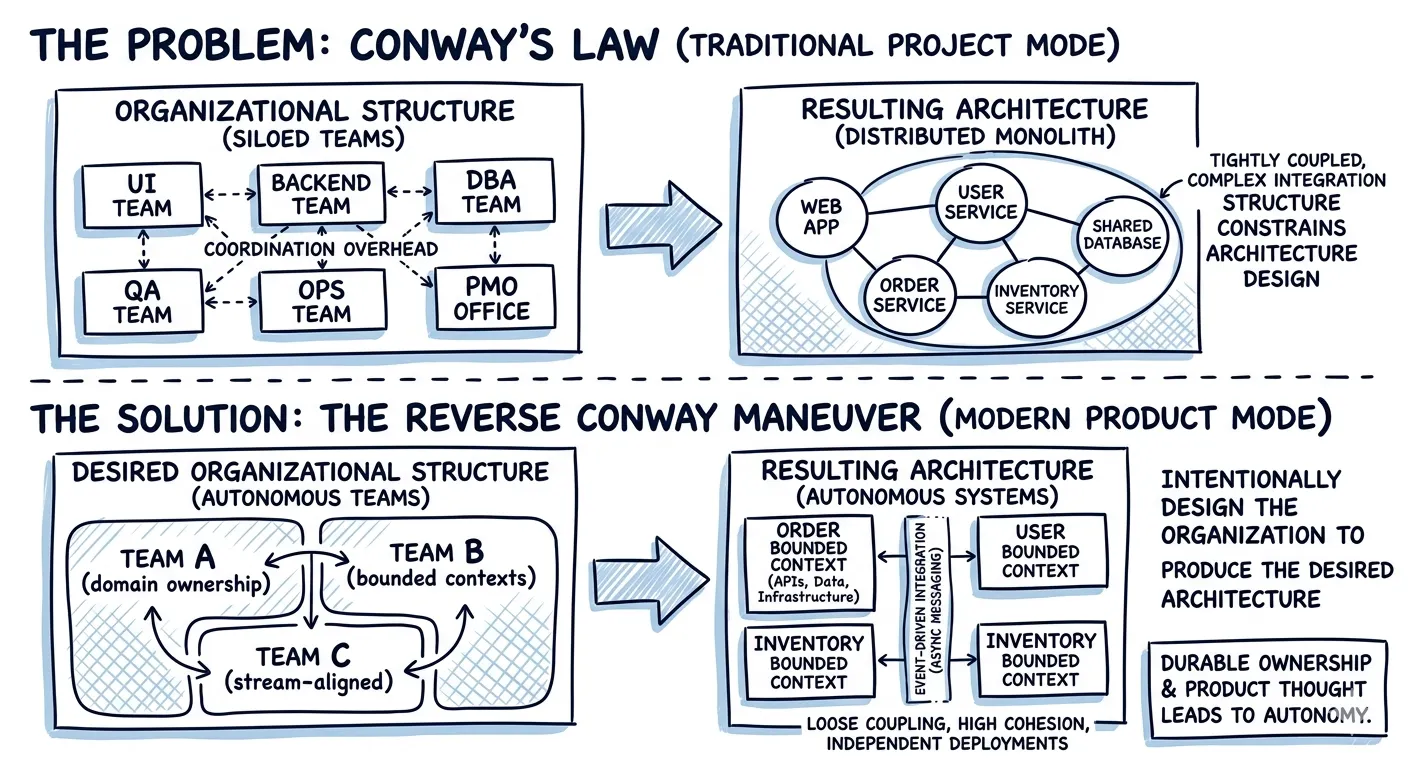
Instead, organizations create distributed monoliths:
- tightly coupled services
- shared databases
- synchronous dependencies
- coordinated releases
- fragile integrations
The technology changes.
The operating model does not.
Conway’s Law wins.
Martin Fowler’s Programs in Product Mode describes successful product organizations as:
“loosely coupled, autonomous teams that respond rapidly to articulated and unarticulated user needs.”
That phrase matters because loosely coupled architecture rarely emerges accidentally.
It usually reflects loosely coupled ownership structures.
Accelerate validated this empirically across thousands of technology professionals. Forsgren, Humble, and Kim observed:
“High performers had loosely coupled architectures. They were able to test and deploy their applications independently, on demand, without requiring coordination with other services.”
The Reverse Conway Maneuver
The Reverse Conway Maneuver is the intentional act of designing organizations to produce the architecture you actually want.
Instead of asking: “How should we structure our systems?”
you ask: “What organizational structure would naturally produce those systems?”
That shift is incredibly important.
If the goal is:
- domain ownership
- bounded contexts
- independent deployments
- event-driven integration
- low coupling
- high cohesion
then the teams themselves must align around those boundaries.
Martin Fowler summarized the challenge bluntly:
“You can change your organization or change your organization.”
The quote sounds circular at first, but the meaning becomes obvious after enough failed transformation programs.
If you want the architecture to change, the communication structure, incentives, governance, and ownership model must change too.
Durable Teams Matter
One of the strongest patterns I have seen in successful organizations is durable ownership.
Teams remain aligned to business capabilities over long periods of time.
They accumulate:
- domain knowledge
- operational understanding
- architectural context
- customer understanding
- historical decisions
- production experience
This dramatically improves:
- delivery quality
- incident response
- architectural consistency
- long-term maintainability
Temporary project teams rarely achieve this.
As Fowler describes in Products Over Projects:
“A product-mode team is funded on a rolling basis … The team takes on one problem after another, roughly the same space, working through an evolving roadmap aligned with product/business strategy.”
That continuity is one of the hidden drivers behind sustainable architecture.
Durable ownership creates durable systems.
The Failure of Project-Mode Thinking
Many organizations still fund work primarily through projects.
Projects optimize for:
- temporary delivery
- timelines
- milestones
- utilization
- task completion
Products optimize for:
- outcomes
- ownership
- evolution
- operational excellence
- customer value
- long-term sustainability
This distinction matters enormously.
Project funding encourages:
- temporary staffing
- fragmented ownership
- short-term tradeoffs
- architectural shortcuts
- delivery pressure over sustainability
Product-mode encourages:
- durable ownership
- investment in maintainability
- platform thinking
- long-term accountability
Without product-mode thinking, Conway’s Law tends to push systems toward fragmentation and coordination overhead.
One of the clearest descriptions of this distinction comes from Fowler’s Products Over Projects:
“A pre-defined solution or outstanding scope gets funded. A team gets funded.”
That difference completely changes organizational behavior.
When funding follows temporary scope, ownership becomes temporary too.
Domain-Driven Design Changes Team Design Too
Many organizations adopt the language of Domain-Driven Design without fully embracing the organizational implications.
Bounded contexts are not just technical boundaries.
They are ownership boundaries.
A healthy bounded context typically includes ownership of:
- APIs
- data
- infrastructure
- deployment
- operational support
- front-end experience
- domain workflows
This is where Team Topologies becomes extremely valuable.
When teams align to business capabilities and bounded contexts:
- communication paths simplify
- cognitive load drops
- ownership becomes clear
- deployments become safer
- coordination overhead decreases
The architecture becomes easier to evolve because the organization itself supports the architecture.
This also reinforces Fowler’s criticism of activity-oriented structures:
“Organizing by activity gets in the way of lowering batch size of work that is handed-off between teams.”
That handoff cost becomes one of the largest hidden forms of enterprise friction.
Coupling vs Cohesion
One of the recurring misunderstandings in enterprise modernization efforts is confusing cohesion with coupling.
Organizations often attempt to “align” teams by forcing:
- shared databases
- shared infrastructure
- centralized services
- common release cycles
This increases coupling.
Healthy architectures instead maximize:
- cohesion inside a bounded context
- loose coupling between bounded contexts
Bounded contexts should collaborate through:
- APIs
- events
- contracts
- asynchronous messaging
not through direct database access or organizational dependency chains.
The same principle applies organizationally.
Teams should collaborate frequently.
But they should not require constant coordination to function.
The strongest organizations I have worked with optimized for clear interfaces, not centralized control.
Event-Driven Design and Organizational Autonomy
One of the strongest architectural patterns I have seen supporting autonomous teams is event-driven design.
Events reduce direct runtime dependency between systems.
Instead of:
- tightly coupled synchronous calls
- orchestrated release coordination
- direct database integrations
systems communicate through published domain events.
This allows teams to:
- deploy independently
- evolve independently
- scale independently
- operate independently
But event-driven architecture only works well when organizational ownership boundaries are equally clear.
Otherwise organizations simply recreate tight coupling through process instead of technology.
I have seen organizations build technically asynchronous architectures while maintaining entirely synchronous approval and governance models.
The result is usually the same coordination bottleneck wearing different technology.
Governance Without Destroying Flow
Large organizations often react to complexity by introducing:
- approvals
- architecture boards
- release committees
- CABs
- centralized reviews
The intention is usually risk reduction.
But excessive governance frequently increases:
- lead time
- coordination cost
- deployment risk
- organizational friction
The highest-performing organizations I have worked with instead relied on:
- automated testing
- CI/CD
- observability
- policy guardrails
- peer review
- platform engineering
- rapid rollback capability
Governance shifted from gatekeeping to visibility.
That distinction matters enormously.
Accelerate confirmed this pattern through empirical research spanning high-, medium-, and low-performing technology organizations:
“We found that the use of a change advisory board (CAB) was negatively correlated with software delivery performance. Approval by an external review body had no positive impact on change failure rate.”
The organizations that move fastest are usually not the organizations with the fewest controls.
They are the organizations where controls are automated, decentralized, and embedded directly into delivery workflows.
Product Owners Need Real Authority
Another common anti-pattern is organizations attempting to create product-oriented teams while withholding actual authority from Product Owners.
In many enterprises:
- Product Owners do not control prioritization
- architecture investment is centrally dictated
- operational work is deprioritized
- reliability work requires approval battles
- delivery metrics dominate outcome metrics
This weakens the entire operating model.
If organizations want autonomous systems, they must empower autonomous teams.
That requires trust.
High-performing organizations understand that accountability without authority is organizational theater.
Teams cannot own outcomes if they are only permitted to own tasks.
Final Thoughts
Conway’s Law is not merely an architectural observation.
It is one of the most important organizational truths in software engineering.
The systems organizations build inevitably reflect:
- communication structures
- ownership boundaries
- governance models
- funding models
- trust structures
If organizations want:
- modular architectures
- independent deployments
- product ownership
- faster delivery
- resilient systems
then they must intentionally design their organizations to support those outcomes.
That is the Reverse Conway Maneuver.
Accelerate’s longitudinal research confirmed what Conway first described. Forsgren, Humble, and Kim found:
“Our research shows that software delivery performance strongly predicts organizational performance, including profitability, productivity, and market share.”
Without it, modernization efforts often become expensive technology rewrites wrapped around the same organizational dysfunctions.
The tools change.
The architecture diagrams change.
But the communication structure remains the same.
And eventually, the systems reflect it again.
References
- Martin Fowler — Conway’s Law
- Martin Fowler — Programs in Product Mode
- Martin Fowler — Activity-Oriented Organizations
- Martin Fowler — Business Capability Centric Organizations
- Martin Fowler — Outcome-Oriented Organizations
- Martin Fowler — Products Over Projects
- Martin Fowler — Team Topologies
- Eric Evans — Domain-Driven Design
- Martin Fowler — Patterns of Enterprise Application Architecture
- Matthew Skelton & Manuel Pais — Team Topologies
- Forsgren, Humble, Kim — Accelerate: The Science of Lean Software and DevOps
- Tradable Quality Hypothesis
- Design Stamina Hypothesis